From a 9th-century hilltop fortress to the most visited monument in Spain. Nine centuries of sultans, conquests, neglect, and rediscovery on Sabika Hill above Granada.
The Alhambra is not a single building but an entire city of palaces, fortifications, gardens, and administrative quarters that accumulated over three centuries of Nasrid rule. The complex we see today is largely the work of four sultans — Yusuf I, Muhammad V, and their predecessors — who transformed a military stronghold into the most architecturally accomplished royal complex of the medieval Islamic world.
Its history is also the history of Al-Andalus in miniature: the last Islamic kingdom on the Iberian Peninsula, holding out against the Christian kingdoms of the north for 254 years before the final surrender in 1492. What followed — centuries of adaptation, neglect, military occupation, and partial destruction — is as significant as the building itself. The Alhambra we visit today is both a monument to what was built and a record of everything that happened to it afterwards.
Check Availability 900 m · Realejo, GranadaThe earliest written reference to a structure on Sabika Hill dates from the 9th century. The Arab historian Ibn Hayyan mentions a "red fortress" — in Arabic, Qa'lat al-Hamra, from which the name Alhambra is likely derived — perched on a rocky promontory above the city. The name may refer to the reddish clay of the original walls, though this remains debated. This early construction was a purely military installation: watchtowers, defensive walls, and a garrison, not a place of residence. The strategic position was its defining quality — commanding unobstructed views over the Darro valley to the north, the Genil plain to the south, and the Sierra Nevada to the east.
In 1238, Muhammad I ibn al-Ahmar entered Granada and established it as the capital of the last Islamic kingdom on the Iberian Peninsula. He immediately began transforming the hilltop into a royal residence, constructing a palace, a water supply system — the Acequia Real, an irrigation channel drawing water from the River Darro several kilometres upstream — and an expanded circuit of defensive walls. Muhammad I is also credited with the first significant residential buildings on the hill. The Nasrid kingdom would survive for 254 years, longer than any other Islamic state in Iberia, in part because Muhammad I agreed to pay tribute to Ferdinand III of Castile in exchange for autonomy — a pragmatic compromise that bought the kingdom two and a half centuries.
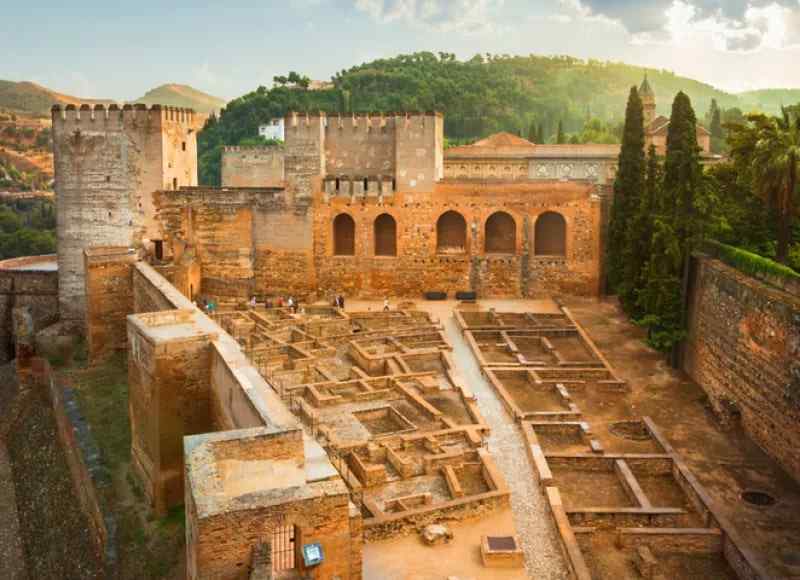
Under Muhammad III (1302–1309) and Ismail I (1314–1325), the Alhambra expanded from a defended palace into a more complete royal city. Muhammad III added a congregational mosque (its site now occupied by the Church of Santa María de la Alhambra) and extended the bath complex. Ismail I began work on a new palace on the western side of the hill and refined the decorative vocabulary that would come to define the Nasrid aesthetic: carved stucco panels, geometric ceramic tile dados, and an elaborate system of Arabic calligraphic inscriptions running as friezes above the tilework. The phrase repeated most frequently across the walls — "There is no victor but God" — was the motto of the Nasrid dynasty.
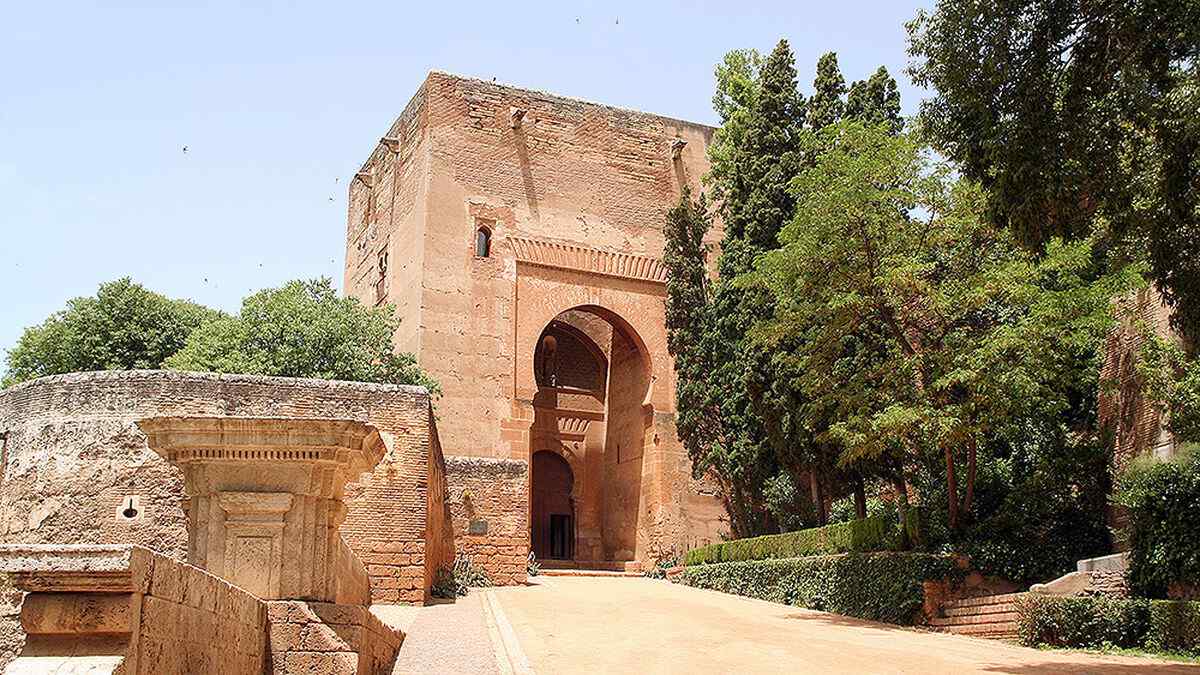
Yusuf I is responsible for some of the most iconic elements of the Alhambra. In 1348, he completed the Puerta de la Justicia — the main ceremonial entrance to the complex — with its horseshoe arch carved with a hand and key. He oversaw the construction of the Comares Palace, including the enormous Torre de Comares, the tallest tower of the Alhambra at 45 metres, which houses the Salón de los Embajadores: the throne room where the sultan received foreign ambassadors, its ceiling a geometric dome representing the seven Islamic heavens. The Royal Baths adjacent to the Comares Palace — among the most complete surviving examples of a medieval Nasrid hammam — also date from this reign. Yusuf I was assassinated inside the mosque in 1354.
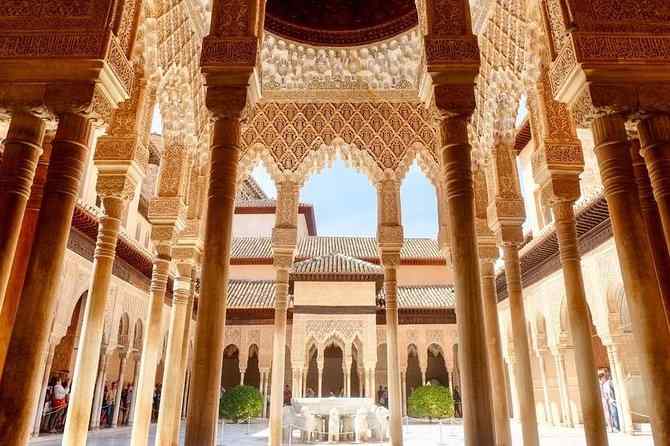
Muhammad V built the Palace of the Lions — universally regarded as the finest achievement of Nasrid architecture — during his second reign (1362–1391). The Patio de los Leones, with its 124-lion fountain and colonnaded galleries, the Hall of the Abencerrajes with its stalactite muqarnas dome, and the Hall of the Two Sisters with its extraordinary honeycomb ceiling vault represent the highest point of Islamic decorative art in the Western world. No building from the medieval Islamic world matches the density of ornamental craftsmanship concentrated in this single palace. Muhammad V also undertook extensive renovations to the Comares Palace, adding the current facing on the Patio de los Arrayanes. His reign is considered the Alhambra's golden age.
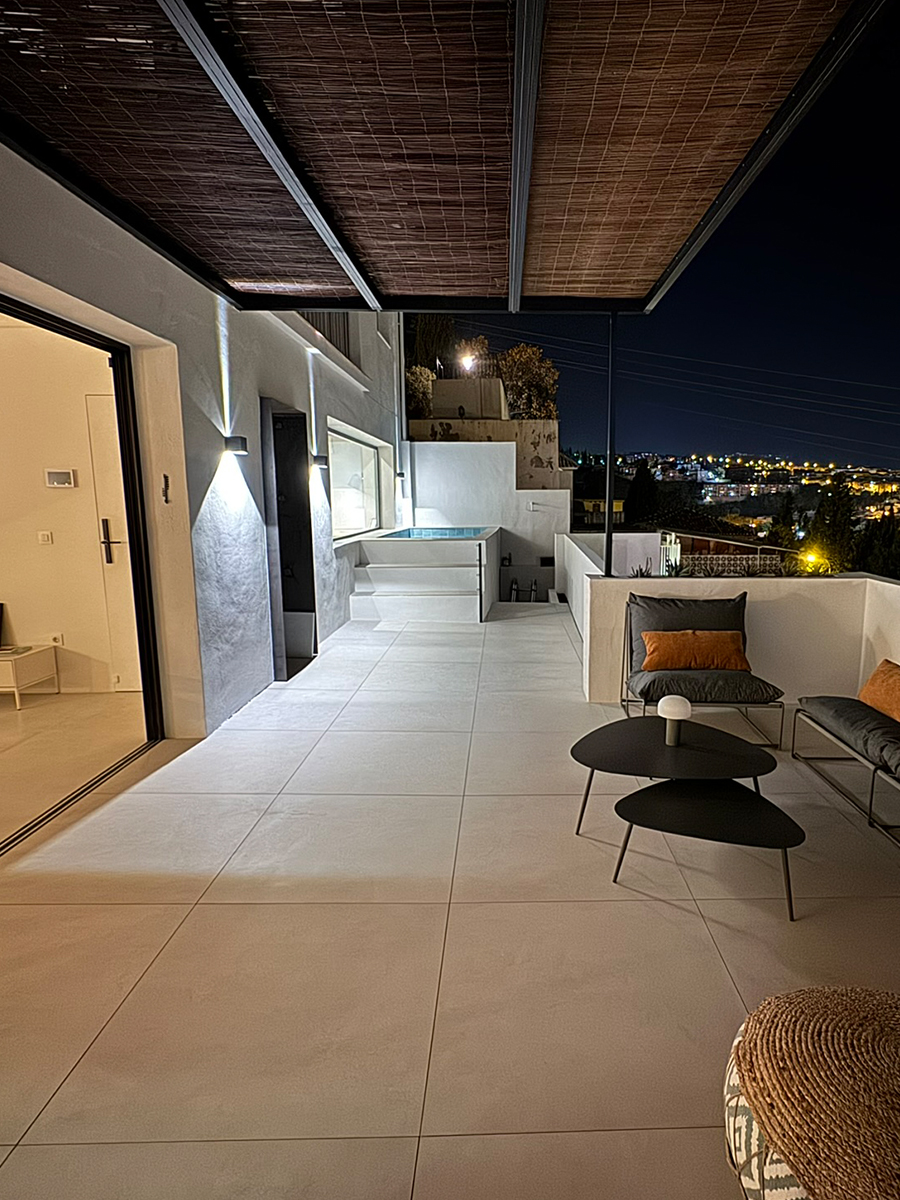
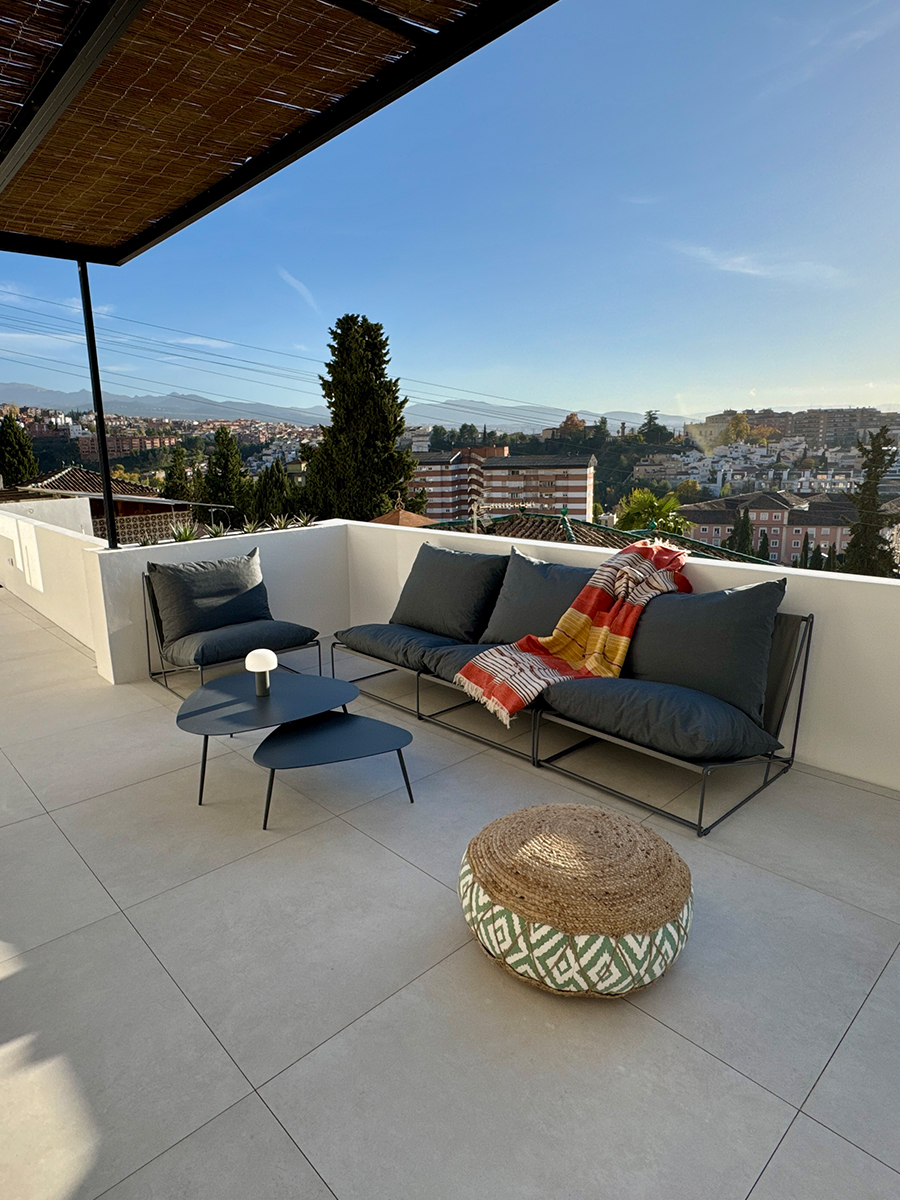
A private apartment 900 m from the Alhambra — with a private pool, panoramic terrace, and direct booking.
On 2 January 1492, Muhammad XII — known to Spanish sources as Boabdil — surrendered the keys of Granada to the Catholic Monarchs, Ferdinand II of Aragon and Isabella I of Castile. The Alhambra passed into Christian hands without destruction. Ferdinand and Isabella chose to preserve the complex, using it as a royal residence and administrative centre. According to legend, Boabdil wept as he left the city, pausing at a mountain pass south of Granada — a point still known as El Suspiro del Moro, the Moor's Sigh — to look back at the Alhambra one last time. His mother, according to the same account, told him he wept like a woman for what he could not defend as a man.
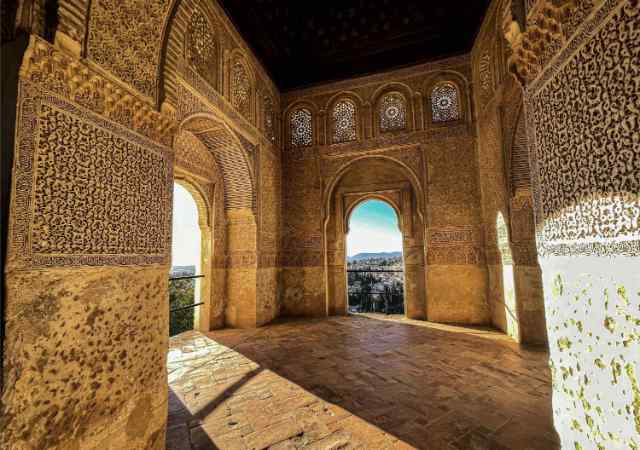
After 1492, the Alhambra was adapted for Christian use. Ferdinand and Isabella renovated rooms for their own residence. In 1527, Charles V commissioned a new Renaissance palace — designed by Pedro Machuca — to be built within the Alhambra precinct, requiring the demolition of part of the Nasrid complex. The palace was never finished and remained roofless for three centuries. The 1522 earthquake damaged several towers. By the 18th century, the Alhambra had been downgraded to a military garrison, its rooms partitioned, its decorations whitewashed, its gardens unkempt. Napoleon's troops occupied the complex in 1812 and detonated several towers when they retreated, causing damage that was only partially repaired. By 1820, squatters and gypsies were living in the ruins.
The Alhambra's modern reputation was largely shaped by Washington Irving, the American writer who spent several months living in the empty palace apartments in 1829 and published Tales of the Alhambra the following year. The book — a mixture of local legend, Orientalist romanticism, and atmospheric description — was an immediate bestseller throughout Europe and America, triggering a wave of artistic and scholarly interest in Granada and Moorish architecture. Irving's visit coincided with a broader Romantic movement fascinated by ruin, antiquity, and the "Orient". Painters, architects, and writers followed in his wake. The Spanish government began the first systematic restoration in the 1830s, led by the architect José Contreras and later his son Rafael, who undertook both genuine conservation work and some controversial reconstructions.
In 1984, the Alhambra was inscribed as a UNESCO World Heritage Site together with the Generalife and the Albaicín neighbourhood. The Patronato de la Alhambra y Generalife now manages the complex, employing specialist conservators and controlling visitor access through timed entry. Approximately 8,000 visitors are admitted per day, with the Nasrid Palaces requiring a specific time slot. Ongoing conservation work continues on the carved stucco surfaces, the hydraulic systems, and the gardens. The Alhambra receives around 2.7 million visitors annually, making it the most visited monument in Spain. The challenge facing the Patronato today is balancing the scale of public demand with the fragility of the materials — carved plaster, painted wood, hand-laid tile — that have survived nearly 700 years.
The Alhambra is not a single building but an entire city of palaces, fortifications, gardens, and administrative quarters that accumulated over three centuries of Nasrid rule. The complex we see today is largely the work of four sultans — Yusuf I, Muhammad V, and their predecessors — who transformed a military stronghold into the most architecturally accomplished royal complex of the medieval Islamic world.
The most widely accepted explanation is that it derives from the Arabic Qa'lat al-Hamra — meaning "red fortress" or "red castle" — a reference to the reddish clay used in the original walls. Some historians suggest it may refer to the colour the walls took on when lit by torchlight during the night-time construction ordered by Muhammad I. The exact etymology is still debated among scholars, but the "red" interpretation is supported by several early Arabic sources.
The Alhambra as we know it was built over roughly 150 years, between the early 13th century and the late 14th century. The most significant phases were under Muhammad I (from 1238), Yusuf I (1333–1354), and Muhammad V (1354–1391). The process was not a single project but a succession of building programmes by different rulers, each adding to or modifying what came before. The Palace of the Lions — the architectural centrepiece — was completed by Muhammad V in the 1380s.
Three sultans stand out. Muhammad I (r. 1238–1273) founded the Nasrid dynasty and began the residential complex. Yusuf I (r. 1333–1354) built the Comares Palace, the Puerta de la Justicia, and the Royal Baths — the monumental public face of the Alhambra. Muhammad V (r. 1354–1359 and 1362–1391) built the Palace of the Lions and brought the decorative programme to its peak. Most of what visitors see today was created by these three rulers across a 150-year period.
After the Reconquista, the Alhambra remained a royal residence under the Catholic Monarchs and later Charles V. Significant modifications were made: a new Renaissance palace was begun in 1527 (never finished), rooms were converted for Christian use, and the mosque was replaced by a church. The complex later declined into a military garrison, suffered earthquake damage in 1522, and was partially destroyed by Napoleon's retreating army in 1812. By the early 19th century it was largely abandoned and in poor condition.
Largely yes. Ferdinand and Isabella chose to preserve the Nasrid palaces rather than demolish them, using the complex as a royal residence and reportedly being struck by its beauty. The main Nasrid rooms survived intact. However, subsequent centuries were less kind: Charles V had parts of the complex demolished to build his Renaissance palace, and Napoleon's forces caused significant structural damage. The 19th-century restorations, while well-intentioned, also involved some controversial interventions. What exists today is the result of continuous adaptation over five centuries.
The Alhambra and Generalife were inscribed as a UNESCO World Heritage Site in 1984. The Albaicín neighbourhood was added to the site in 1994. UNESCO recognition led to significantly increased international interest and visitor numbers, and prompted more rigorous conservation standards. The Patronato de la Alhambra y Generalife, which manages the complex today, was reorganised in the 1980s partly in response to the demands of UNESCO management.
Terraza 6 is a private apartment in Realejo, about 900 m from the Alhambra entrance. Private pool, panoramic terrace, free parking, and direct booking.
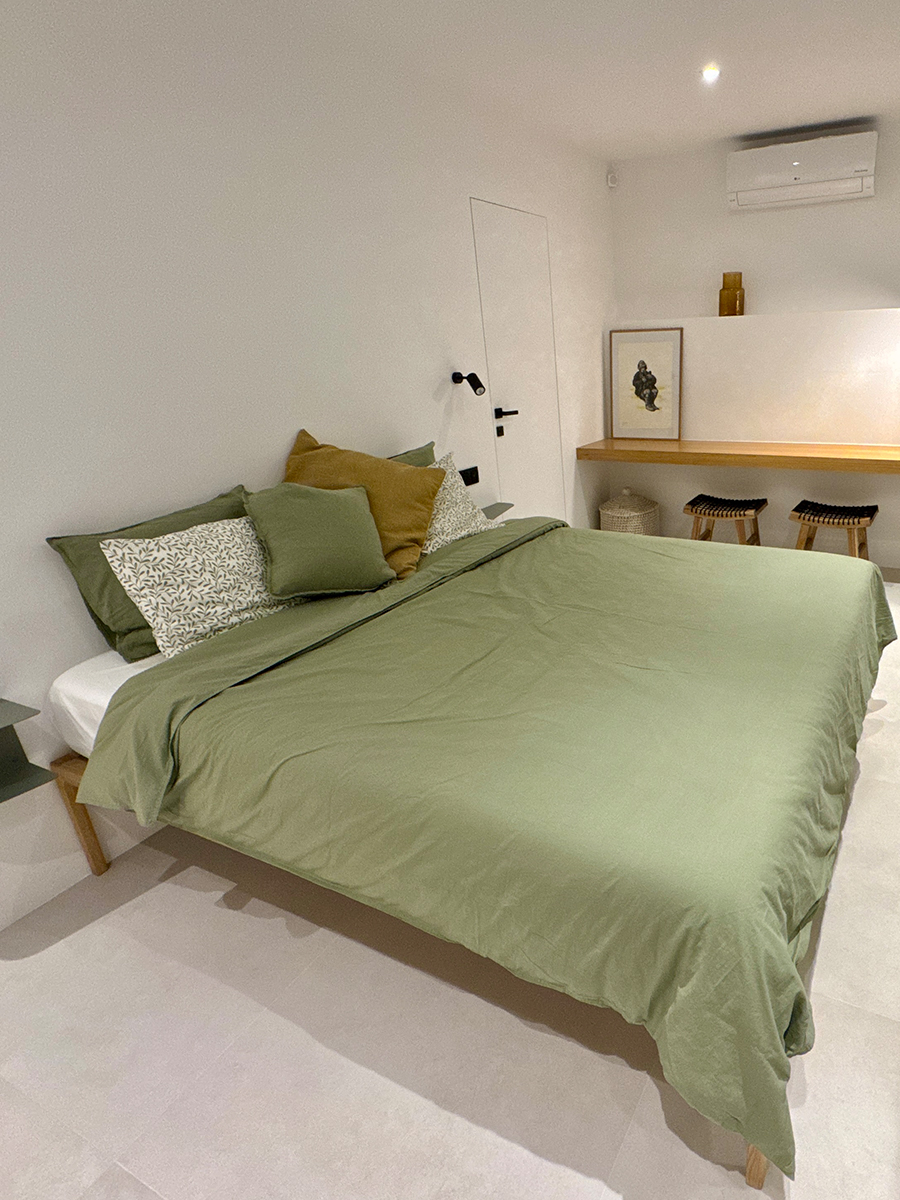
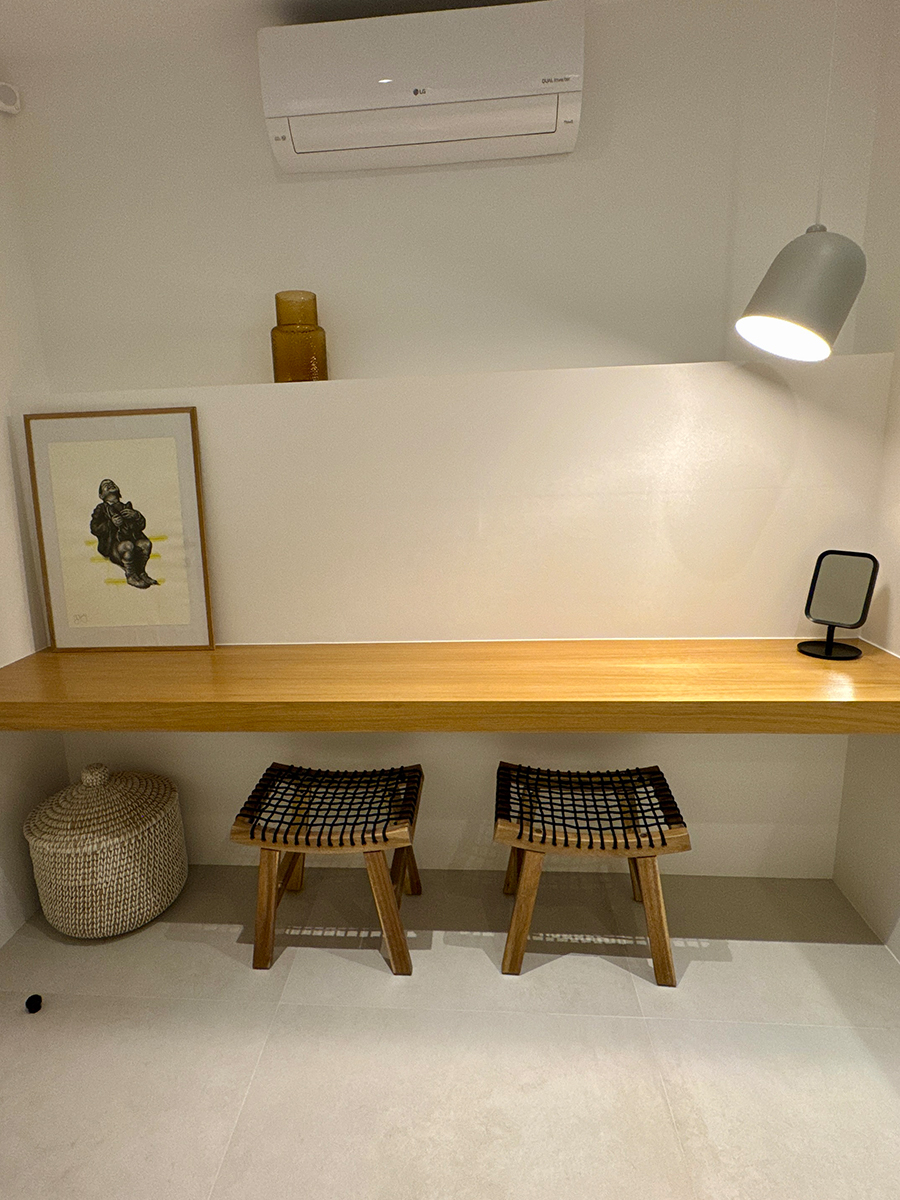
No booking fees. Direct contact with the owners.Terraza 6 is a luxury apartment in Granada with a private pool, a spacious terrace with panoramic city views, and every comfort you'd want during a stay in Andalusia. It's designed for people who want more than a standard rental — somewhere with real character, thoughtful details, and a direct link to one of Spain's most remarkable cities.
The Alhambra, the Albaicín, and some of the best tapas bars in the country are all within easy reach. We know Granada well and share everything we've learned with every guest — from the most useful practical tips to the places most visitors never find.
Booking direct means you deal with us personally. We're easy to reach and happy to help before, during, and after your trip.